
Till now, we have seen different types of analysis. If you have not seen those posts, you can check them out here. From this post, we are going to start something new. So far, we have seen different types of analysis in random order. From this post onwards, we will try to analyze systems and perform various types of analysis in conjunction.
For this analysis, we will start with a handgun model. The handgun I have selected is the Desert Eagle, a very famous handgun known for its deadly power.
So, any guesses on what types of analyses we have to perform for a handgun?
First of all, the type of FEA analysis we need to perform depends on the need for which we are evaluating the product. So, in the case of handguns, we evaluate them for performance, safety, and reliability. So we will perform analyses related to these for the firearms.
Now, let’s look at some of the analyses we will perform.
Structural Analyses
- Static Stress Analysis – Evaluate stresses and deformations under firing loads, recoil forces, and handling forces. Helps identify weak points in the frame, barrel, or slide.
- Dynamic/Transient Analysis – Simulate the rapid pressure rise and recoil during firing. Useful for understanding time-dependent stresses and vibrations.
- Fatigue Analysis – Predict the lifespan of components under repeated firing cycles. Critical for parts like the barrel, slide, and trigger mechanism.
Thermal Analyses
- Steady-State Thermal Analysis – Assess heat distribution during continuous firing. Important for the barrel and chamber, where temperatures rise significantly.
- Thermal-Structural Coupled Analysis – Study how thermal expansion affects tolerances, clearances, and accuracy. Prevents jamming or misalignment due to heat.
Vibration & Modal Analyses
- Modal Analysis – Identify natural frequencies and mode shapes of the handgun. Prevent resonance that could affect accuracy or durability.
- Harmonic Response Analysis – Study how the gun responds to cyclic loads (e.g., recoil oscillations). Helps in tuning ergonomics and recoil management.
Impact & Contact Analyses
- Explicit Dynamics / Impact Analysis – Simulate accidental drops or collisions. Ensures the handgun can withstand impact without catastrophic failure.
- Contact/Assembly Analysis – Study interactions between moving parts (slide, trigger, magazine). Helps refine tolerances and reduce wear.
Material & Safety Analyses
- Fracture Mechanics – Predict crack initiation and propagation under firing stresses. Ensures safety and reliability.
- Buckling Analysis – Check slender components (like springs or pins) for stability under load.
Optional Advanced Studies
- Multiphysics Coupling – Combine fluid dynamics (gas expansion in chamber) with structural FEA. Gives a more realistic simulation of firing events.
- Ergonomic/Grip Pressure Analysis – Simulate how forces transfer to the user’s hand. Useful for design optimization and comfort.
Note: Since this involves firearms, actual FEA studies must comply with legal and ethical standards. The analyses above are purely technical categories applicable to any mechanical CAD model with moving parts, not instructions for weapon design.
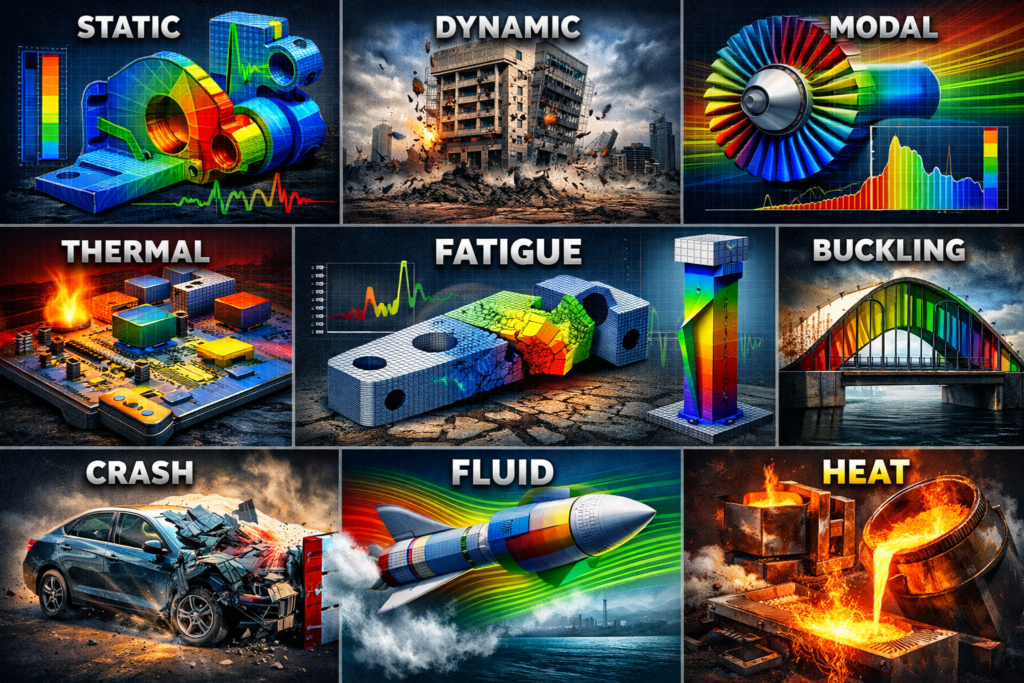
| FEA Type | Handgun Component(s) | Purpose / Relevance |
| Static Structural Analysis | Barrel, Slide, Frame | Evaluates stresses and deformations under firing loads and recoil forces. |
| Dynamic/Transient Analysis | Slide, Recoil Spring, Trigger Mechanism | Captures time-dependent behavior during firing cycles, recoil, and slide movement. |
| Modal Analysis | Barrel, Slide, Grip | Identifies natural frequencies and vibration modes to prevent resonance during firing. |
| Thermal Analysis | Barrel, Chamber, Slide | Assesses heat buildup from repeated firing and its effect on material strength. |
| Fatigue Analysis | Barrel, Slide, Frame | Predicts lifespan under cyclic loading (repeated firing stresses). |
| Contact/Nonlinear Analysis | Barrel–Slide interface, Trigger–Hammer interface | Models friction, wear, and nonlinear contact behavior between moving parts. |
| Buckling Analysis | Magazine walls, Thin grip panels | Ensures slender components don’t deform under compressive loads. |
| Crash/Impact Analysis | Grip, Frame | Simulates accidental drops or impacts to check durability. |
| Fluid-Structure Interaction (FSI) | Barrel, Chamber | Models the interaction between expanding gases and structural response during firing. |
| Heat Transfer (Transient) | Barrel, Chamber | Studies rapid temperature rise and cooling between shots. |
From the next post onwards, we will be starting with structural analyses for the handgun model.
This is all for this post. Hope you got to learn something new from this post. Don’t forget to follow my Facebook and Instagram pages for regular updates. See you all in the next post. Till then, keep learning.